Dr. Leung, SUNY Poly Students Publish Research on New Supernova Models
Published:
Tuesday, April 14, 2026 - 10:45
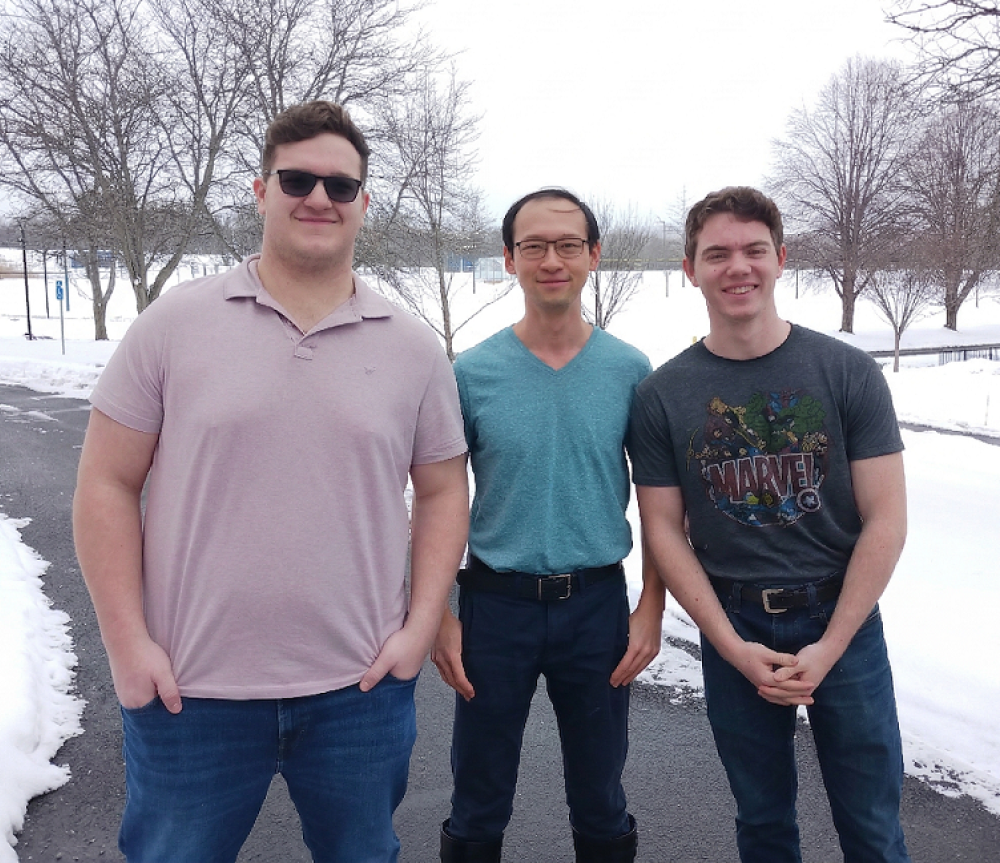
SUNY Polytechnic Institute (SUNY Poly) Assistant Professor of Physics, Dr. Shing-Chi Leung, has published an article in the Astrophysical Journal alongside students Seth Walther (junior, majoring in Electronic and Computer Engineering and Applied Mathematics, with a minor in Physics) and Henry Yerdon (junior, majoring in Electronic and Computer Engineering and Computer Science, with a minor in Physics). The article, titled “Revisiting the Perseus Cluster II: Metallicity-Dependence of Massive Stars and Chemical Enrichment History” (ApJ 1001, 72, 2026), is also co-authored with Dr. Ken’ichi Nomoto, Professor Emeritus at the Kavli Institute for the Mathematics and Physics of the Universe (Kavli IPMU) at The University of Tokyo, and Dr. Aurora Simionescu, Senior Scientist at the Netherlands Institute for Space Research (SRON).
The Perseus Cluster is a massive galaxy cluster located in the constellation Perseus. It is one of the largest structures in the observable universe, comprising more than a thousand galaxies—equivalent to roughly a thousand trillion times the mass of the Sun. Hot gases within the cluster, known as the intracluster medium (ICM), emit powerful X-rays detectable by telescopes. These gases are produced by billions of supernova explosions, and their chemical composition reveals how typical supernovae have exploded throughout cosmic history.
Observational data from the legacy Hitomi telescope (also known as Astro-H) indicate that theoretical models predict too much silicon and sulfur, and too little argon and calcium. These elements are abundantly produced by massive stars—those with masses 10 times that of the Sun or greater—suggesting that current models of massive stars and their supernova explosions need to be revised to align with these observations.
In a series of four journal articles, the research team systematically develops new models of massive star evolution and their subsequent spherical explosions, calibrated using updated observational data. In Paper I, the team introduced new massive star models in which the chemical abundances of silicon, sulfur, argon, and calcium match those observed in the Perseus Cluster.
In Paper II, the team expands these calculations to include a wide range of metallicities (a measure of initial metal content, which correlates with cosmic age) and stellar masses, from 15 to 60 solar masses. These models are then integrated into a galactic chemical evolution pipeline to examine how successive generations of supernova explosions accumulate heavy elements and contribute to the formation of new stars. Through this process, the team reconstructs supernova explosion history and tracks the evolution of individual elements over the past 10 billion years, producing the patterns observed today.
The participating students, both physics minors, joined the research team in summer 2024 (Seth) and spring 2025 (Henry). They contributed to key calculations and authored sections related to their work.
Seth reflected on his experience: “I have truly enjoyed the opportunity to participate in undergraduate physics research. I believe research teaches lessons that are far more applicable to the real world than any standard class, because it pushes you to meet deadlines, face challenges, and learn how to overcome them. Although it can be difficult at times, it is incredibly rewarding to explore ideas you might never have encountered otherwise. Astrophysics focuses on understanding the fundamental processes that shape the evolution of our universe and how we came to be, and it is some of the most fascinating work I will ever have the chance to do. I am sincerely thankful to Dr. Leung for allowing me to be part of these projects, and I hope more students will consider pursuing physics research in the future.”
Henry also shared his experience: “When I entered college, I knew I had an interest in physics, particularly astrophysics. About a year and a half in, when I had the opportunity to participate in astrophysics research, I took it without hesitation. The experience was not exactly what I had imagined, but it was fascinating and eventful in ways I never expected. Research taught me that things do not always go smoothly—significant effort is required to achieve results, and those results may not always meet expectations. It also showed me that dedication and resilience are essential to accomplishing meaningful work. I spent many long nights working on this project and writing my sections of the paper, but I would do it all again for the incredible experience it provided. I will always be proud to see my name among the authors of a published article, and I am deeply grateful to my mentor, Dr. Leung, for including me in his research.”
Dr. Leung commented on the project: “I am very excited that the legacy measurements from Hitomi on the Perseus Cluster have led to this series of articles, which have applications not only for the Perseus Cluster, but also for Milky Way stars, metal-poor stars, and galaxies. The next-generation telescope XRISM, launched in 2024, will continue to provide exciting new data, including precise measurements of supernova remnants and galactic objects. These discoveries will help advance the development of next-generation stellar and supernova models.”
The team will continue to investigate how these newly calibrated models behave under extreme conditions, such as bipolar explosions.
This project is supported by the National Science Foundation under grant AST-2316807.