SUNY Poly Expands Research Capabilities Through High-Performance Computing System
Published:
Wednesday, November 4, 2026 - 13:15
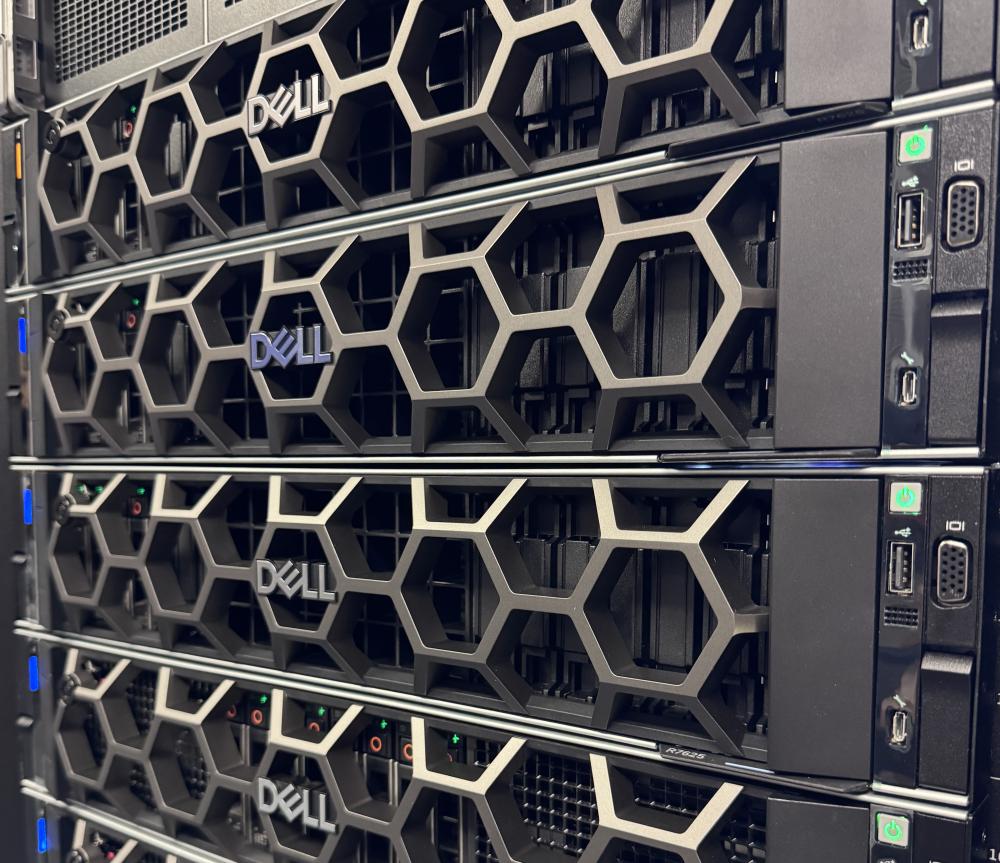
UTICA, NY – Researchers at SUNY Polytechnic Institute (SUNY Poly) are harnessing the power of high-performance computing (HPC) to tackle complex scientific challenges, accelerate discoveries and advance research across multiple disciplines.
Developed and configured by SUNY Poly's Information Technology Services (ITS) department, the HPC system provides researchers with powerful computing resources capable of processing massive datasets, performing complex calculations and running multiple computational tasks simultaneously.
With 24 NVIDIA graphics processing units (GPUs), including A100 and H100 models, along with one terabyte (TB) of memory and 128 CPU cores per server, the system delivers the computational power needed to process massive datasets and perform complex calculations. Combined with approximately one petabyte (1,000 terabytes) of storage capacity, these resources support demanding research in artificial intelligence, mathematical modeling and genomic analysis.
“This system represents an important investment in SUNY Poly’s growing research enterprise and the infrastructure needed to support increasingly complex scientific discovery,” said Dr. Michael Carpenter, Vice President for Research. “Our ITS team deserves tremendous credit for the time, expertise and dedication required to bring these capabilities online. Their work is providing our faculty researchers with powerful tools to accelerate discoveries and pursue new research opportunities.”
The system includes six computing nodes and a management server and is designed primarily for faculty-led academic research. Student participation is limited to those working under faculty supervision who have the necessary technical knowledge. The system supports specialized software applications for mathematical calculations, scientific modeling and Python-based research, with ITS providing technical assistance and support.
Accelerating Genomic Research
For Dr. Adam McLain, Professor of Biology, the system has played an important role in research examining how primate genomes change with age.
With assistance from SUNY Poly ITS staff, McLain used the system to assemble genomic data from 106 individual primates representing six species. The DNA was sequenced at the University of Wisconsin-Madison, producing enormous quantities of raw genetic data requiring substantial computing power to process.
The HPC system allowed researchers to organize billions of DNA base pairs into chromosomes and reconstruct complete genomes, which were then compared across juvenile, mature and elderly animals to investigate changes associated with aging.
“Sequencing these genomes generated massive amounts of raw data, essentially billions of individual DNA bases that needed to be assembled into complete genomes,” McLain said. “With the computing resources available here at SUNY Poly, and significant assistance from ITS, we were able to reconstruct these genomes and compare them across different age groups.”
McLain and his research team are preparing its first publication based on the findings.
Advancing Artificial Intelligence Research
The system has also become an essential resource for artificial intelligence research led by Dr. William Thistleton, Associate Professor of Mathematics and Co-Director of SUNY Poly's Artificial Intelligence Explorations (AIX) Center.
“The Poly HPC has been central to our research,” Thistleton said. “Desktop machines work well for inference, but training takes far more memory and compute than a desktop can offer, and our team could not have trained our models without the HPC.”
According to Thistleton, the system offers significant advantages in speed, scale and the ability to conduct multiple experiments simultaneously. A model that might require three days to train on a laptop can be completed in just a few hours using the HPC system.
“When we needed to test thirty experimental conditions, the HPC ran them all at once instead of one after another, turning a month of work into a few days,” Thistleton said.
The system also provides controlled computing environments that help researchers reproduce results, an important consideration for peer-reviewed scientific research.
As research increasingly relies on large datasets, advanced simulations and artificial intelligence, SUNY Poly’s HPC system will continue to support interdisciplinary collaboration and strengthen the University's research capabilities.